Green Soul : l’anthropocène : cultures, arts, imaginaires – Paul Ardenne
Avec Green Soul. L’anthropocène : cultures, arts, imaginaires, Paul Ardenne poursuit son exploration des liens entre création contemporaine et crise…
Internaturalism. For an hybridisation of human and non-human.
To talk about Internaturalism – a concept introduced by the Palermitan semiologist Gianfranco Marrone (Addio alla Natura, ‘Farewell to Nature’, Einaudi 2011) – means, first of all, to assert the existence of multinaturalism, a concept which, given the recurring use of prefixes (multi, inter, trans etc.), is the clear outcome of another concept, also composed by two terms: multiculturalism. The underlying idea, especially in the field of anthropology and in the recent advancements in sociology, is that the plurality of cultures, which are increasingly closer and necessarily coexisting into our societies, does not spring from a background of uniform nature. Therefore, it is not about one nature to which one can refer according to one’s own cultural filters and standards, rather, it is about as many natures as are the cultures talking about them and dealing with them. And the boundary between the one and the other varies depending on the case, to the extent that the oppositions nature/culture arrange themselves in different ways, depending on how we are accustomed to think of them. Then, there are “bundles in which nature and culture are inextricably intertwined”.[1]
Thus, from multiculturalism we get to multinaturalism (and therefore assert the existence of several a priori conflicting interpretations), and “the natures that cultures talk about (as talking about nature, in a wordplay, is the same as talking about man talking about nature)”,[2] require therefore a new conjugation. In this sense, the French anthropologist Philippe Descola reflects upon two new possible categories: the human and the non-human, in other words (although simplifying – author’s note), what does or does not belong to the human sphere, being humanity intended as a concept comprising not only man and his kin, but rather all living beings (plants, animals, minerals) with whom one can have social interaction or kinship bonds. In several cultures, both of the past and current ones, the distinction between that which is human (and therefore, as superior, having power over others) and that which is not (and therefore inferior, lacking own rights and thus exploitable) has no grounds. There are populations, for instance, some Amerindian communities, for whom animal and plants have a soul just like human beings. And for this reason they are considered ‘people’ with whom to establish specific relationships. Embedded in Internaturalism is ultimately the need to understand natural differences, and, rather than a concept, the term is the expression of the desire to build a common ground – perhaps just a recombination and perhaps non definitive – which could at least assimilate the natural alterity to which we all belong. Differences which we all bear, both culturally and naturally.[3] The prefix inter-, in connection with forms of naturalism, is compulsory when differences meet. In the future, and perhaps in a time not so far away, we will probably witness a radical shift from internaturalism to crossnaturalism, where the prefix cross- will sanction the actual hybridisation between alterities.
The exhibition Internaturalism, with a title which is also the 2013 general theme of PAV, as well as the main subject of the international conference held on the day following the opening of the exhibition (8 May 2013), retraces many of the premises herein discussed. The works on display in this milieu of interdisciplinary crossings (from ethology, to biology and anthropology, with frequent references to eco-activism and biopolitical criticism) reveal the fundamental role of contemporary art as a significant vehicle of social bonds and understanding of the world surrounding us. And they are works able to turn into facts abstract meanings related to the environment and the ecological issues, stimulating knowledge and understanding (or triggering reactions) of such topics as global warming, the loss of biodiversity and pollution.
The exhibition opens with a glowing statement which reads nature loves to hide. The installation by Filippo Leonardi (1970, Catania) is a declaration that stands as a further question about the position of the contemporary man in relation to nature. Through Heraclitus’ aphorism[4] the artist reaffirms first of all that nature is a subject, as it has feelings, in a way. The feeling is not just any feeling, specifically, “it loves”. In addition, he exhorts the audience to wonder whom would nature want to hide from; why it would not want to reveal itself; what instruments it uses to disguise itself and, especially, who is entitled to unveil it. Leonardi thus becomes he who tries, with his narrations, to describe nature, appointing the artist as the chosen translator to uncover its mechanisms.
Another luminous work, presented by the young Uli Westphal (1980, Berlin), enhances one of the four viewpoints embraced by the artists in Internaturalism in order to observe natural multiformity. Adding to his biopolitical reading and to his criticism to the capitalistic commercialisation of nature, in fact, we find the anthropological perspective, the ethological study of the animal world and the biological or organic analysis of matter, intended therefore as the proximity of the human sphere to nature. In Shelf Life Westphal leads the audience into an ordinary supermarket in order to show them the twisted techniques of seduction and marketing elaborated to attract the attention of the consumer. Westphal ridicules the marketing system which almost phobically imposes ever more ‘natural’, or even ‘super-natural’ food. In the artwork, a series of neon tubes, ranging from purple, to pink, and yellow, reproduces the lighting system used in the aisles of supermarkets to light up the merchandise. The colour intensity varies depending on the product presented, with the clear intention to enhance the ‘freshness effect’ of i.e. meat (blue and pink) or baked products (yellow).
The video Workshop_23/New Alliances by the American group Critical Art Ensemble stands as a testimony of the journey begun at PAV in November 2011, which showed the possibility of an artistic-participative method.[5] As an actual creative action, New Alliances consists in empathising with one another thus acknowledging that the biological and cultural precariousness is equally shared by all living organisms. Therefore, likening endangered plants to the communities of citizens, whose social spaces are unstable or threatened, the CAE suggests becoming active subjects again, to reverse precariousness into a positive force, creating a socio-political symbiosis between plants and people.
The works by Piero Gilardi (1942, Turin) and Andrea Caretto | Raffaella Spagna (1971, Turin; 1967, Rivoli) investigate instead the area of biological affinity between body and living matter. With his tunnel-shaped interactive installation, Gilardi welcomes the audience to drink a glass of water to experience the assimilation of liquids. Leaning on a rocky surface made of polyurethane foam, the visitor looks onto artificial scenery replicating an Alpine valley. As the liquid pours down the oesophagus, an actual stream of water springs from the installation flowing into the sea, reproduced in the final video. The body goes through the physical experience of the source of a river, its course and flow into the sea, reflecting upon the organical symbiosis between man and nature (after all, the human body is 60% water), and on the meaning of existence in its continuous and cyclical course.
With Corpo Esteso (‘Expanded body’), Caretto and Spagna explore another material field: the mineral world. The question of what is and what is not organic is no longer asked, rather, experimenting the boundary shared by both the different modalities of matter and the ‘biological’ connection of man with his habitat, Corpo Esteso is displayed as a sort of wall library. With its shelves jotting out, the installation is an open journal of the artists’ relationship with the mineral world. Taking the distance from what is considered mineral in the common imagination – usually thought of in the form of a crystal – in the work there appear pieces of plaster, clay sculptures, synthetic material waste and casts.
On display in the mid of the greenhouse, the heart PAV’s exhibition space, there is 108, Luana Perilli’s installation (1981, Rome). It is a terrarium similar to a living wunderkammer for the study of the behaviour of some species of insects, so-called eusocial, organised into castes and characterised by a strong sense of altruism towards their own colony, even to the point of self-sacrifice to defend the nest. In her work, Perilli creates a room-like setting with items of furniture, in which she introduces a colony of ants of the species Polyrhachis Dives. Originally from Asia, this insect builds its home weaving nests thanks to the materials collected (branches and leaves). In this species, the perception of the needs of the individual is cancelled in favour of a group vision, typical of a collective dimension. Perilli’s work originates from within the desire of human projection, somehow sympathetic towards the community, to be taken as a model of social solidarity.
Henrik Håkansson’s work (1968 Helsingborg, Sweden) too adopts an interdisciplinary approach that combines ethological, anthropological and aesthetic aspects. The observation of a specimen of Hoverfly, similar to a bee of the family of the Syrphidae, constitutes the scientific basis of a wider reflection on the possible forms of relationship between man and nature, and the utilitarian mechanisms of protection of some species.
Of an anthropological nature is also Mixture of plants by Gabriella Ciancimino (1978, Palermo) consisting of a sound installation and a book-like artefact. The artist explores the different interpretations of the Edelweiss, one among the most damaged and endangered species worldwide. Created in Graz during a stay in the city, the work is the direct elaboration of the research carried out on the Austrian traditions related to the flower, an element that is not only vegetable, but also deeply cultural and symbolic. The conversation with Christian Berg, botanist of the Botanical Garden of Graz, as well as clarifying the morphogenesis and evolution of the Edelweiss, reveals, at once, the different cultural interpretations of the flower. While the Edelweiss is still among the most celebrated symbols of Austrian national pride, in Italy, it was adopted as a symbol of resistance only during the Second World War. Alongside the piped echo of the voice of the botanist, broadcast as if in a radio interview, Colombaia mobile (‘Pigeon Coop’) by Filippo Leonardi also features on display in the c courtyard of PAV. This is the transportable miniature of a dovecote used by dove breeders, reproduced in accordance with the ergonomic standards of habitability. Colombaia mobile is conceived as a means to connect two spaces, the one fixed and the other movable, involving a pair of carrier pigeons. Contrary to the collective imagination that views the pigeon as a social scourge to be eradicated with various stratagems, it has in fact a long history and a rich literature. Using the birds to connect different places, Leonardi intends to reflect upon the cultural need to organise into categories and, in particular, upon the prejudices and clichés that, once assimilated, underpin feelings of acceptance or rejection.
Halfway between anthropology, ethology, social criticism and reinterpretation of ancient myths, there are also the works by Norma Jeane, Brigitte de Malau and Laurent Le Deunff. These are permanent installations in a state of becoming that, placed in the park of PAV, stand as relational spaces to be experienced or through which to observe life in its constant change.
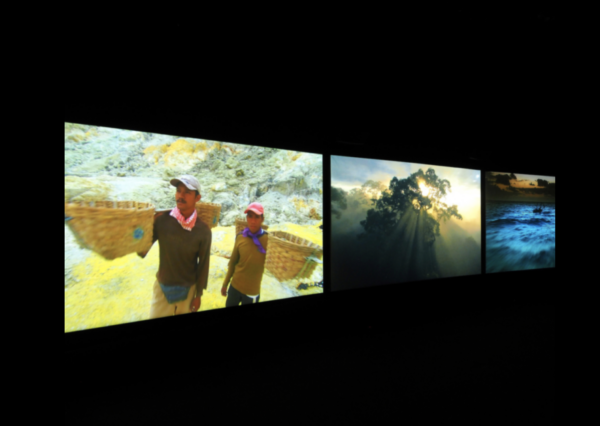
Finally, in the project room the video Perpetual Amazonia by Lucy + Jorge Orta (1966, Sutton Coldfield, UK; 1953, Rosario) is shown in double projection. It is a thorough reflection upon the concept of biodiversity and its prospects of preservation and conservation. In the video, the audience is attracted by the evocative images and the sounds recorded by the artists during an expedition undertaken with a team of scientists in the Peruvian rainforest. A poem by Mario Petrucci narrates in the form of a dialogue (between Gaia and man) the various habitats explored during the trip. Led in the heart of the forest, the visitor is then invited to wonder what future can be pictured for the biosphere surrounding us. As a memento – Sic vos non vobis – that the planet, a common good like its elements, is “for us but not ours”.
The works of the sixteen artists in the exhibition are but a small part of the multiple narratives of nature; they are tales of Internaturalism able to trace a potential hybridisation between the different meanings of nature. The nature to be re-invented encompasses then a social, collective nature, which is not only a common good for humanity, but for all living beings.
Claudio Cravero, main curator of the PAV / Parco d’Arte Vivente of Torino
Avec Green Soul. L’anthropocène : cultures, arts, imaginaires, Paul Ardenne poursuit son exploration des liens entre création contemporaine et crise…
La fondation Thyssen-Bornemisza Art Contemporary inaugurera un centre pluridisciplinaire dédié aux océans à Venise.
Publié par Wild Project, ce livre retrace un projet unique, la création dans l’agglomération bordelaise de 11 Refuges périurbains, 11…